AI will increase productivity and will continue dropping the price of software development towards near zero. A side effect is that we tend to accumulate software technical debt faster than we can review it. Technical debt is a familiar idea in software: take the shortcut, move fast, accept that someone solves later, pays later, with interest.
There is a second debt with the same structure and a different creditor. Call it moral debt. Economists have a name for its mechanism: externalities, costs that are real but absent from the price you pay per token. The data centers behind these tools draw water, energy and land from the places that host them. A 100 MW facility consumes roughly the water of 2,600 households per day.
The benefits concentrate on whoever ships faster; the costs disperse across a watershed, a grid, a community that voted on none of it. This is a common goods problem, and using the tools while knowing the bill exists is the debt.
Localization of AI value is part of the solution. Elinor Ostrom won a Nobel for showing that communities manage shared resources well when the rules are local: clear boundaries, rules fit to the place, users who answer to each other. The resolution of the commons problem is solving local problems.
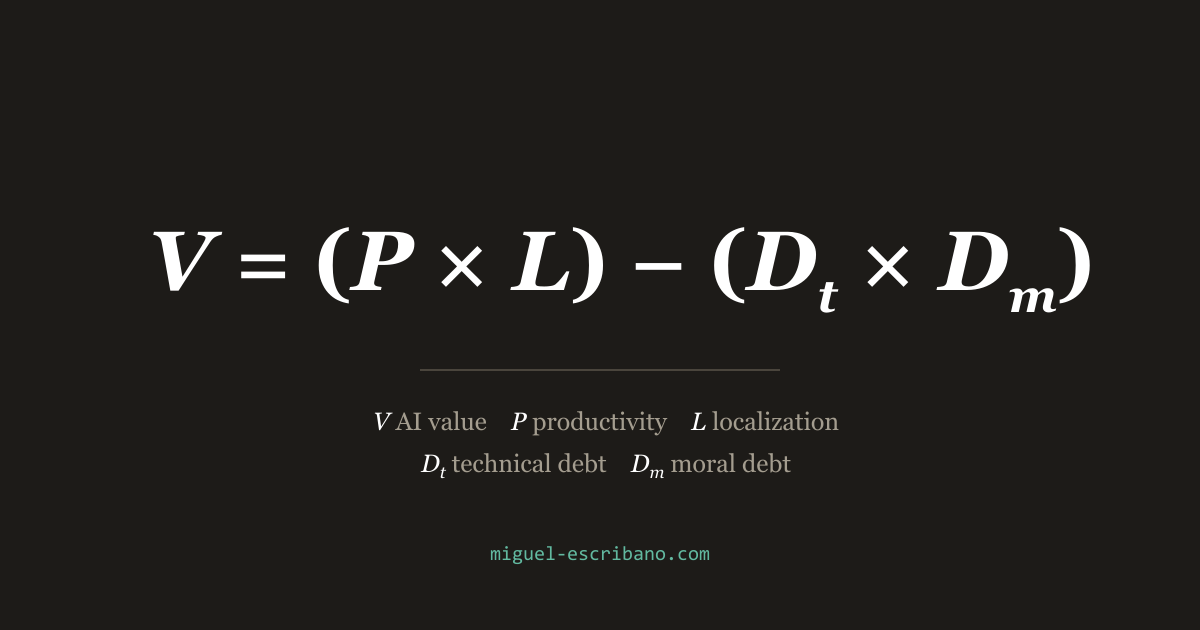
That points to where real value comes from:
AI value = (Productivity × Localization) − (Technical Debt × Moral Debt)
Let’s use AI to solve the problems of our local community.